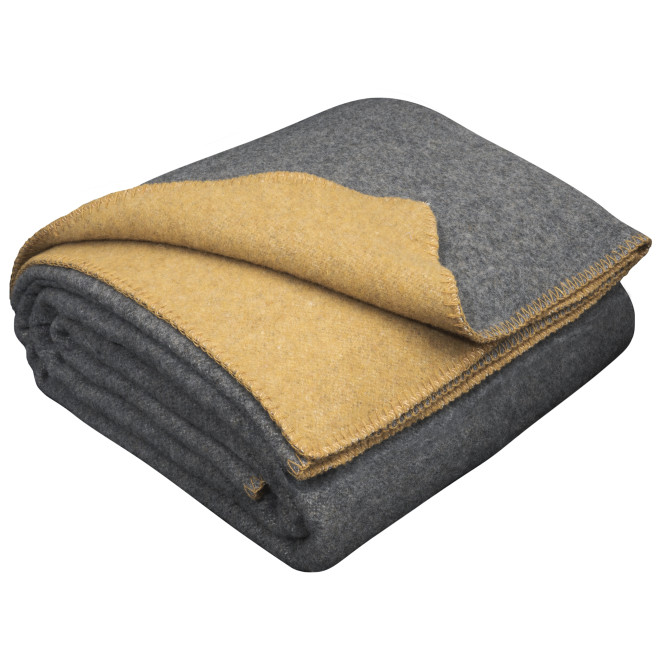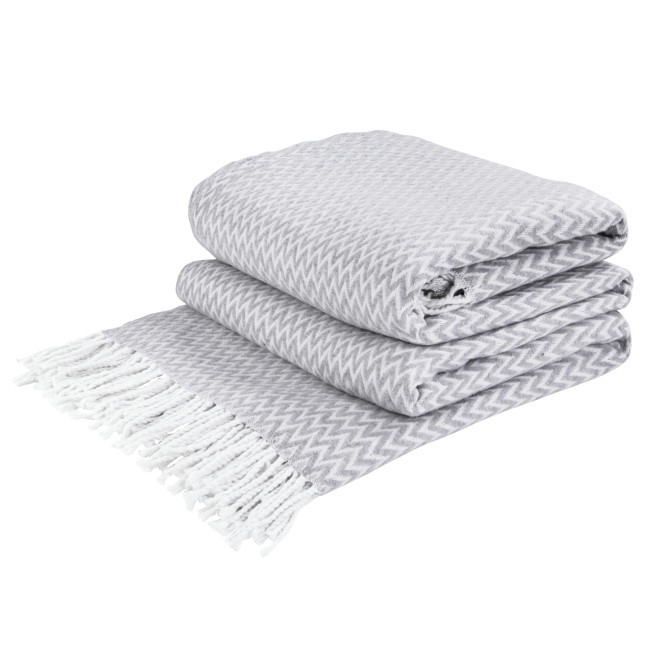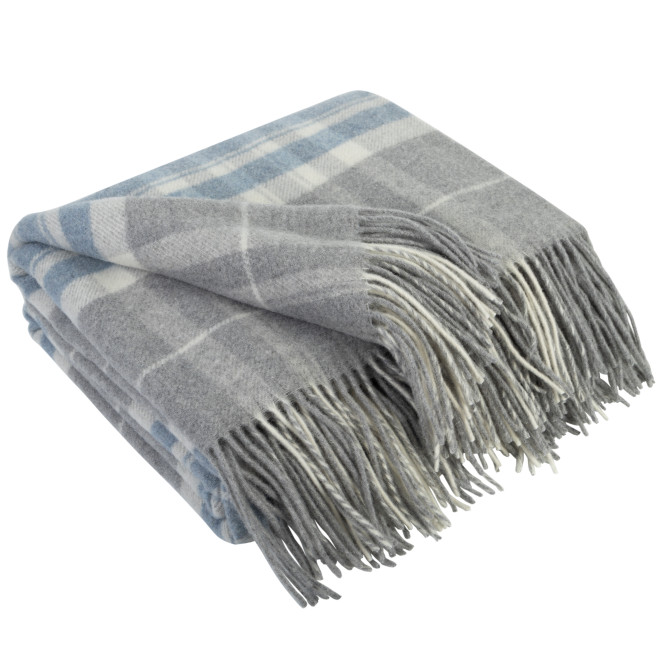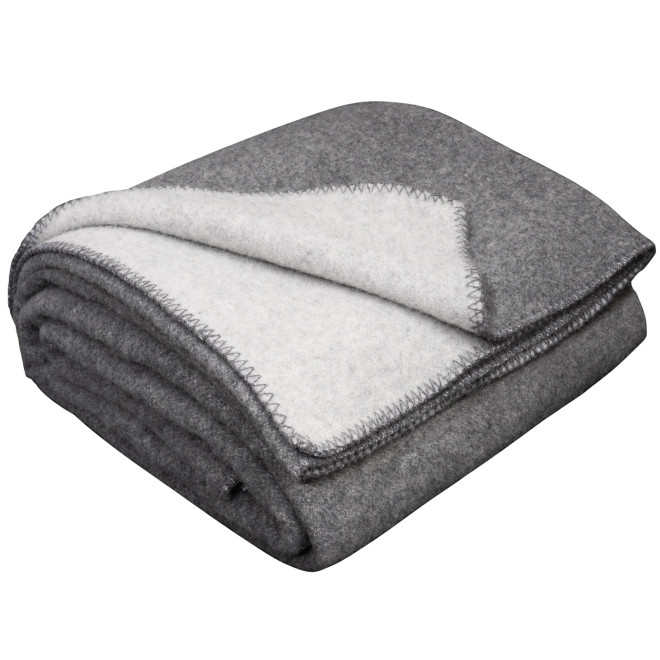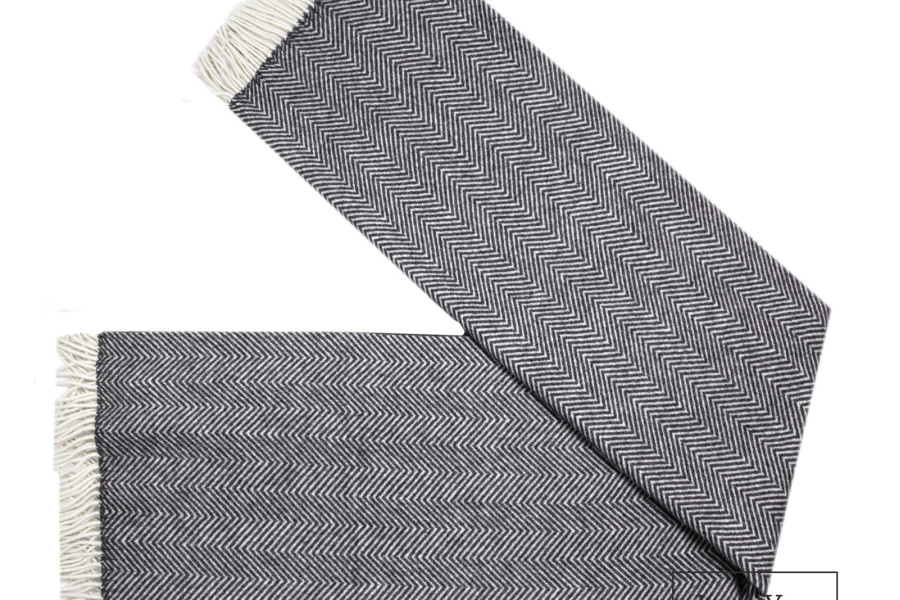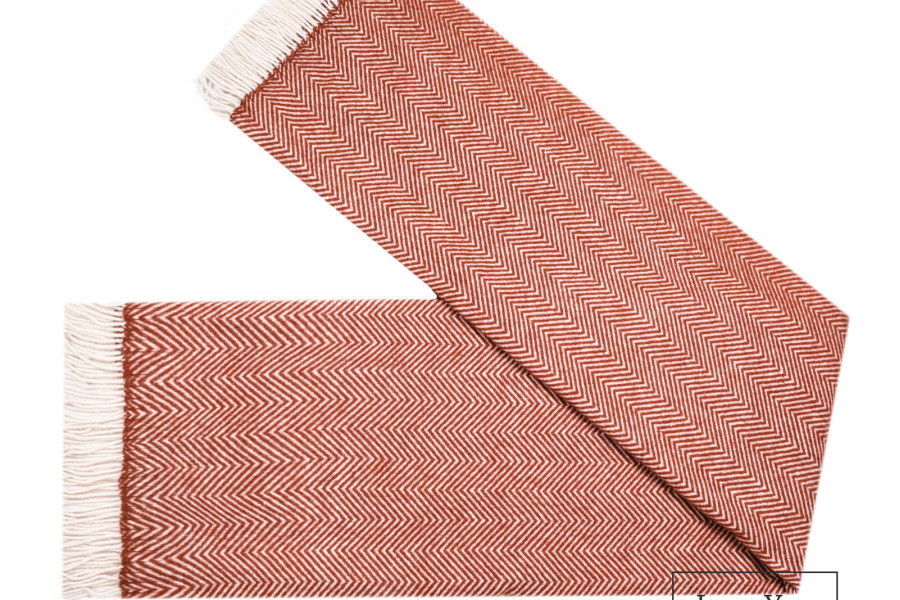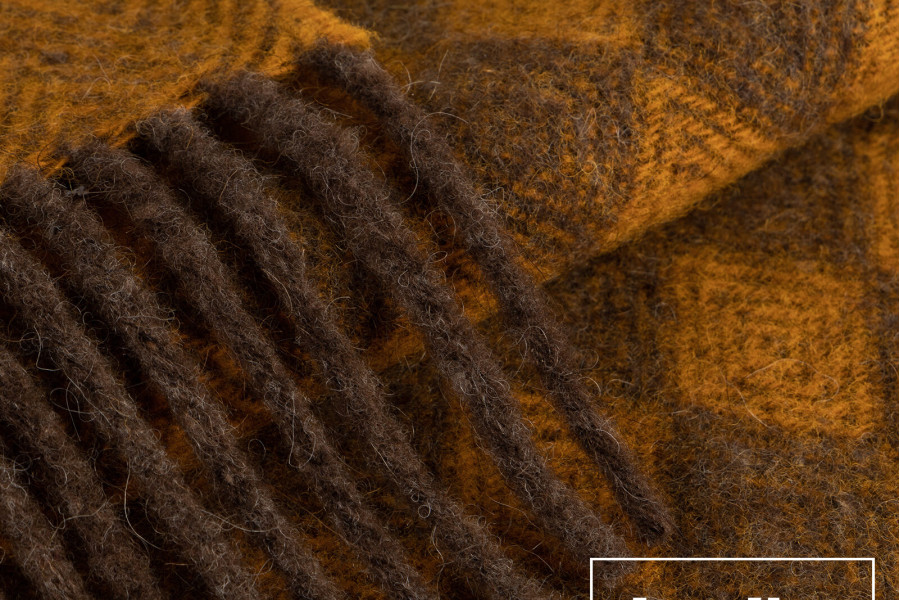
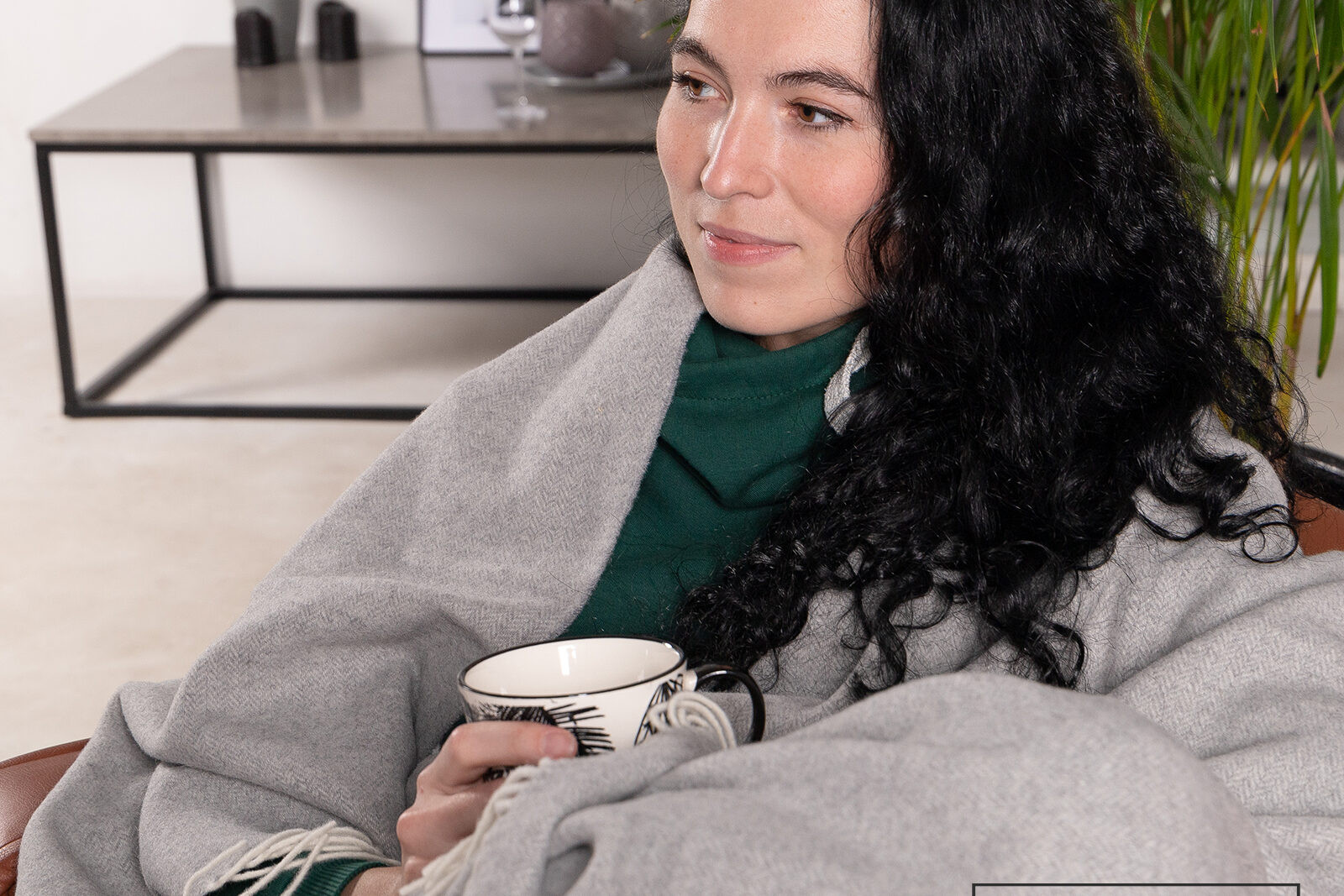
In a merino cashmere throw that is 90% merino wool and 10% cashmere, the cashmere changes the feel: the surface is softer and smoother in the hand than merino on its own. It doesn't turn the throw into a cashmere throw, and it doesn't make it warmer. On our own five-point scale, our cashmere-merino throws rate 5/5 for softness and 4/5 for warmth; our merino throws rate 4/5 for both.
So the honest answer is that 10% cashmere buys you softness. You pay more than for merino and far less than for pure cashmere, and you get a throw that feels noticeably finer than merino alone, while the merino does most of the work. Below: how fibre content is labelled, what to make of "cashmere feel", why pure cashmere costs what it does, and how to look after a blend.
How fibre content is labelled
In the UK, a textile label must list the fibres a product is made of, with each one's share as a percentage of the total weight, largest first. The fibre names are fixed by the labelling rules, so a maker can't invent its own. That makes the composition label the one place where a throw can't be vague.
- "90% merino wool, 10% cashmere" means a tenth of the fibre by weight is cashmere. In our 655 g throw, that is about 65 g.
- "100%" or "pure" may only be used when a product is made of a single fibre.
- "Cashmere", sometimes written "cashmere wool", always means hair from the cashmere goat, never sheep's wool.
Product names are shorter than labels, and a blend is often sold simply as a "cashmere throw" or "cashmere blanket". That is why we give the composition every time we mention ours: 90% merino wool, 10% cashmere. Whatever a throw is called, the percentage tells you how much cashmere is in it.
"Cashmere feel" and other words that aren't on the label
"Cashmere feel", "cashmere touch" and "cashmere-soft" describe how something is meant to feel, not what it is made of. A throw sold with these words often contains no cashmere at all; many are acrylic or polyester brushed to a soft finish. There is nothing wrong with a soft synthetic throw, but it is a different product at a different price. Before you buy anything with cashmere in the name, check three things:
- A percentage next to the word cashmere. If the composition gives no cashmere percentage, there is no cashmere in the fabric.
- What the rest is made of. 10% cashmere with 90% merino wool is a wool throw. 10% cashmere with 90% acrylic behaves mostly like acrylic.
- Size and weight. Together they tell you how much throw you get for the price. Ours measures 140 × 200 cm, including 10 cm fringes, and weighs 655 g.
What 10% cashmere adds, and what it doesn't
Cashmere fibres are generally finer than merino, which is why they feel so soft; our article on merino, cashmere and pure new wool explains the difference in detail. Mixed into merino, a tenth of cashmere softens the handle and gives the surface a smoother touch. You notice it most when you run a hand across the throw or pull it up round your neck.
What it doesn't do is just as useful to know:
- It doesn't add warmth. Warmth comes mostly from how thick and dense a throw is, and on our scale the cashmere-merino and merino throws both rate 4/5.
- It doesn't make a cashmere throw. With 90% merino wool, it looks and behaves like a fine wool throw with a softer finish.
- It doesn't change the care. The label says do not wash, as on our merino throws.
- It doesn't stop bobbling. Fine, soft fibres can form small bobbles where a throw gets the most wear; a wool comb takes them off.
One difference from our merino throws has nothing to do with the cashmere. The merino throws are 80% merino wool and 20% nylon; the cashmere-merino has no nylon, so every fibre in it is merino wool or cashmere.
Merino or cashmere-merino: our two throws compared
| Merino | Cashmere-merino | |
|---|---|---|
| Made of | 80% merino wool, 20% nylon | 90% merino wool, 10% cashmere |
| Sizes | 130 × 170, 140 × 200 (with fringes) and 150 × 215 cm | 140 × 200 cm, including 10 cm fringes |
| Weight | 730–1,450 g | 655 g |
| Softness (our scale) | 4/5 | 5/5 |
| Warmth (our scale) | 4/5 | 4/5 |
| Designs | The widest choice of colours, double-sided or patterned | Herringbone, stripes, tartan |
| Price | £49.90–69.90 | £84.90–89.90 |
| Care | Do not wash: air it or dry clean | Do not wash: air it or dry clean |
Choose cashmere-merino if softness is what you are paying for, or as a present for someone who notices texture. Choose merino if you would like more sizes and colours, the heaviest throw (150 × 215 cm, 1,450 g) or the lower price.
Why pure cashmere costs so much more
Cashmere is the fine undercoat of the cashmere goat, combed out in spring when the goats shed their winter coat. Each goat gives only a few hundred grams a year, so a throw of pure cashmere takes several goats' worth of combing. That is why a throw woven entirely from cashmere usually costs hundreds of pounds, and why a cashmere throw at an everyday price is usually a blend.
A blend puts the cashmere where you feel it and lets merino carry the rest: the structure, the warmth and most of the weight. The more cashmere in the blend, the closer it feels to pure cashmere and the higher the price. At 10%, our cashmere-merino throws cost £84.90–89.90, with free UK delivery from our warehouse in Coventry. Only a few are in stock in the UK at the moment, and the designs available can change.
How to care for a merino-cashmere throw
Follow the label, which says do not wash. Day to day, that is less work than it sounds:
- Air it. Hang it outdoors for a few hours, out of direct sun and rain. Fresh air lifts the fibres and carries smells away.
- Brush it. A soft clothes brush, used in the direction of the fibres, takes off dust and fluff.
- Deal with spills at once. Blot, don't rub, and treat only the stain.
- Dry clean it when it needs more than air. The label specifies solvent P, which your dry cleaner will recognise.
- Store it clean and dry over the summer, loosely folded in a breathable cotton bag, where moths can't get at it.
Some owners decide to wash wool at home anyway. Our guide to washing a wool blanket explains how to do it as gently as possible on a wool programme, but with this throw that is at your own risk, since the label says not to.
FAQ
Is a merino cashmere blanket warm?
Yes. Ours, with 90% merino wool and 10% cashmere, rates 4/5 for warmth on our own scale, the same as our merino throws. The cashmere adds softness rather than warmth.
Is a cashmere blend throw worth it?
If softness matters to you, yes: ours, with 10% cashmere, is the softest throw we make. If warmth, size or price matter more, a merino throw does the same job for less.
Is a cashmere wool blanket different from a cashmere blanket?
Not on the label: "cashmere wool" is another name for cashmere, the hair of the cashmere goat. Check the percentage to see how much of it the blanket contains.
Does a cashmere blend throw bobble?
It can, where it gets the most wear, as most soft wool does. Take the bobbles off gently with a wool comb.